Wuxi Weineng Automation Technology Co., Ltd. / Shandong Weineng Automation Technology Co., Ltd.
-
 [email protected]
-
 +86-18961722255


 English
 русский
 Español

Coil-Fed Laser Blanking: A Practical Guide for Metal Forming and Spring Teams
Content
- 1 What Coil-Fed Laser Blanking Actually Does
- 2 Why It Attracts Spring and Suspension Manufacturers
- 3 Where Coil Handling and Unloading Decide the Result
- 4 Advantages That Matter on the Shop Floor
- 5 Limitations and Costs to Plan For
- 6 Coil-Fed Laser Blanking vs. Die Blanking
- 7 How to Judge a Coil-Fed Laser Blanking Line
Coil-fed laser blanking looks simple on paper: uncoil the metal, level it, feed it, cut the blank shape with a laser, and unload the finished part. In a real plant, the difference between a workable line and an expensive bottleneck usually comes down to coil handling, nesting strategy, scrap removal, and how smoothly the blank moves into the next forming or heat-treatment step.
For spring, stabilizer bar, and suspension component manufacturers, the process is worth understanding because it changes the economics of blank geometry. It can reduce dependence on hard tooling and make low-volume or frequent-changeover work more practical. It also asks the production team to think differently about cycle time, line layout, and downstream flow.
What Coil-Fed Laser Blanking Actually Does
A coil-fed laser blanking line takes material from a coil rather than from pre-cut sheets. The strip is uncoiled, straightened or leveled, and fed into a cutting zone. One or more laser heads then cut the required blank profile. The finished blank is separated from the skeleton, conveyed away, and stacked or presented to the next operation.
- Uncoiling and leveling prepare the strip and reduce coil set before cutting.
- A loop or accumulator allows the line to feed smoothly without stopping the coil continuously.
- A servo feed or gripper system positions the strip accurately under the laser head.
- The laser cuts the blank contour, holes, notches, or relief features in one setup.
- The blank is unloaded, stacked, or transferred to a press, furnace, or assembly station.
- The remaining skeleton is chopped, wound, or removed as scrap.
Some lines cut while the strip is indexed and stationary; others use a continuous or “on-the-fly” approach with multiple laser heads. The choice affects accuracy, cycle time, accumulator design, and how much programming logic is needed to keep the line balanced.
The laser head is only one part of the investment. The uncoiler, leveler, feed, scrap system, stacking device, and safety enclosure often decide whether the line runs reliably shift after shift.
Why It Attracts Spring and Suspension Manufacturers
In leaf spring production, blanking is the first point where part geometry, material utilization, and downstream forming are linked. A laser-blanked coil line can change from one blank profile to another without a new die. That is useful for prototype work, low-volume variants, and programs where the blank shape is still being refined.
If you are comparing process routes, our guide to automated blanking lines for leaf springs explains how press-based blanking handles high-volume leaf spring work. Laser blanking is not a replacement for every press line; it is a different answer for flexibility, tooling cost, and changeover speed.
At Wuxi Weineng, our work centers on automated lines and equipment for leaf springs, hot-wound springs, stabilizer bars, guide arms, and related metal parts. That background shapes how we look at coil-fed laser blanking: as a line-integration question, not just a machine specification sheet.
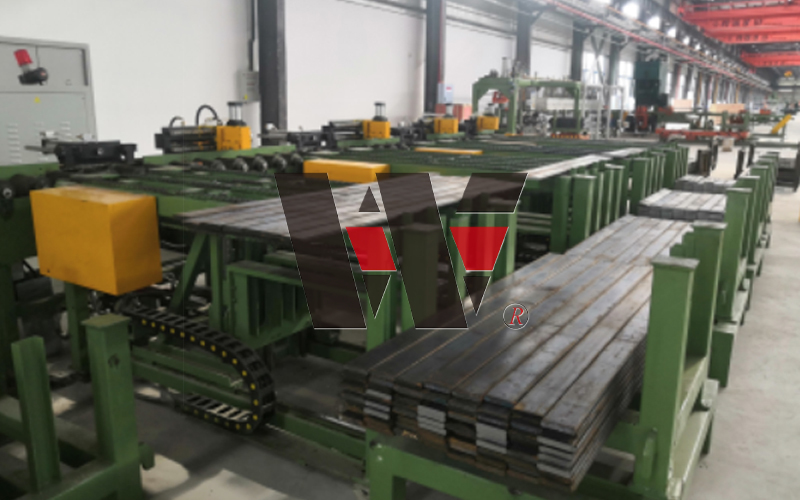 Fully Automatic Leaf Spring Blanking and Punching LineFor high-volume, stable hole patterns, this integrated line combines automatic blanking with localized hot punching for automotive leaf springs.View Product →
For teams comparing a laser-only blank with a punched blank, a fully automatic blanking and punching line may still be the better fit when volume is high and hole patterns are stable. The right choice depends on the part family, not on the word “laser” alone.
Where Coil Handling and Unloading Decide the Result
A coil-fed laser blanking line is only as good as its material path. Poor leveling can leave residual bow or twist that shows up later as inconsistent forming. Weak loop control can cause feed hesitation, marking, or cut-quality variation. A well-designed line keeps the strip flat, the feed repeatable, and the cutting zone isolated from vibration.
- Coil weight and width determine uncoiler, leveler, and foundation requirements.
- Strip thickness and material grade affect laser power, cutting speed, and assist gas choice.
- Nesting software influences material yield, skeleton design, and scrap handling load.
- Stacking quality affects how easily the blank can be picked, formed, or heat treated.
Unloading deserves early attention. A fast laser cannot compensate for a stacker that marks parts, misaligns them, or forces manual intervention. The blank should leave the line in a condition that suits the next operation, whether that is a press, a furnace, or a buffer station.
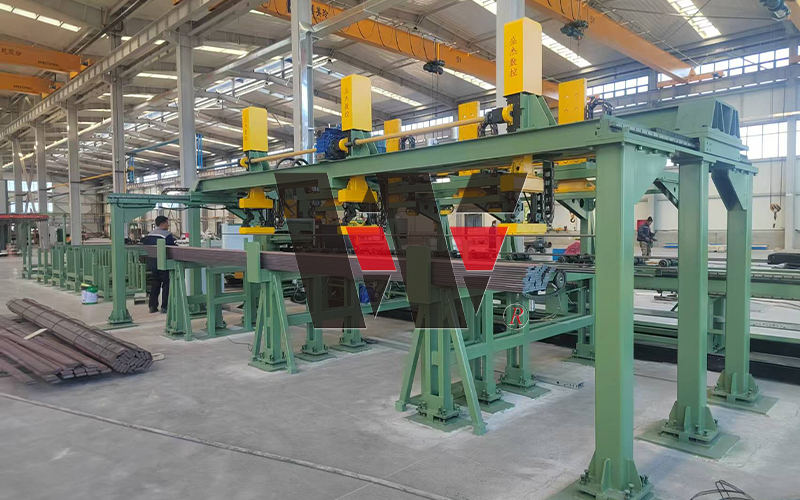
 Fully Automatic Leaf Spring Shearing and Unloading LineThis automated shearing and unloading line supports mass leaf spring production with precise cutting, hydraulic shears, and handling for downstream press or furnace flows.View Product →
Scrap removal is the other quiet constraint. Laser-cut skeletons can be long, flexible, and awkward to handle. The line needs a scrap strategy that matches the nesting pattern and the available floor space, not a generic chopper added at the end of the project.
Advantages That Matter on the Shop Floor
- Fast changeover from one blank profile to another, without waiting for a new die.
- Lower tooling cost for low-volume, prototype, or frequently revised parts.
- Flexible nesting that can improve material utilization when part shapes allow it.
- No die wear or press tonnage limitation for the blanking cut itself.
- Easier integration of holes, notches, and contour features in one cutting step.
- Less floor space than a large press line in some layouts, especially when coil handling is compact.
These benefits are real, but they are not automatic. A laser blanking line with poor nesting discipline or slow unloading can lose much of its flexibility advantage. The process pays back best when changeover frequency, part mix, or tooling cost is a genuine pain point.
Limitations and Costs to Plan For
- Capital cost can be high once coil handling, laser protection, software, and stacking are included.
- Cycle time may be longer than a dedicated press line for simple, high-volume blanks.
- Thick or highly reflective materials can require careful laser selection and process validation.
- Assist gas, power, optics, and preventive maintenance add ongoing operating cost.
- Cut edges and heat-affected zones may need review for downstream forming or fatigue-critical parts.
- Programming and nesting skills become part of the production capability, not just an office task.
The honest comparison is not “laser versus press” in the abstract. It is a comparison of part family, annual volume, changeover frequency, material yield, labor, maintenance, and the cost of holding a die library. A line that is excellent for mixed production can be the wrong tool for a single blank made in millions.
Coil-Fed Laser Blanking vs. Die Blanking
The table below is a practical starting point for a make-or-buy discussion. It is not a substitute for a trial cut or a line simulation, but it helps frame the trade-offs that matter before equipment selection.
| Decision area | Coil-fed laser blanking | Conventional die blanking |
|---|---|---|
| Changeover | Fast, mostly software and feed setup | Die change and setup time |
| Tooling | Low die cost; higher line and software cost | High die cost; lower line cost for simple parts |
| Best fit | Mixed parts, prototypes, low to medium volume | Stable high-volume parts with mature design |
| Cycle time | Dependent on contour length, thickness, and laser heads | Usually fast for simple profiles |
| Material use | Can improve with nesting, but skeleton scrap remains | Depends on strip layout and die design |
| Operating focus | Optics, gas, nesting, feed control, unloading | Die maintenance, press uptime, lubrication |
For a leaf spring or suspension part, the decision often comes down to how many variants the plant expects and how much the blank design may still change. If the part is mature and volume is steady, a press line can be very efficient. If the plant is managing many profiles and shorter runs, laser blanking can reduce the friction of change.
How to Judge a Coil-Fed Laser Blanking Line
Start with the part family, not the laser
List the blanks you expect to run over the next three to five years: material grade, thickness, width, contour complexity, hole count, annual volume, and changeover frequency. A line that is ideal for thin, nested blanks may struggle with thick, narrow strips or parts that need tight edge quality.
Check feeding, nesting and scrap
Ask how the line handles coil set, strip flatness, loop control, and cut-to-cut accuracy. Review nesting examples using your own parts, not just a demonstration file. Then follow the skeleton: how it is cut, conveyed, and removed. Scrap handling is a common source of downtime when it is treated as an afterthought.
Connect the blank to the next operation
A blank is only useful if it enters the next process cleanly. Consider stack height, part orientation, surface marks, and buffer capacity. In spring and stabilizer bar production, the blank may move into hot forming, end processing, drilling, or heat treatment. The line layout should make that transfer short and predictable.
- Ask for a cycle-time study based on your real contour length and material thickness.
- Review laser safety, fume extraction, and enclosure access for maintenance.
- Confirm who owns nesting recipes, cut parameters, and spare-parts strategy.
- Check how the line recovers after a missed feed, a cut fault, or a stacker jam.
Coil-fed laser blanking is a strong option when flexibility, tooling cost, and part mix matter more than raw blanking speed. It is less convincing when a single mature part runs at very high volume and the die line is already efficient.
The practical answer is to evaluate the blanking step as part of the whole production flow. At Wuxi Weineng, we have spent years around the forming, heating, end processing, and assembly equipment that follows blanking, so we tend to ask a simple question first: what does the next station need from this blank? When that answer is clear, the equipment decision becomes much easier.
-
Do You Have Any Questions?
Let's
Discuss! -
Quick
Home Products / Equipment About Us Services Application News Contact Us -
Product Categories
Automobile Leaf Spring Complete Equipment Automobile Stabilizer Bar Complete Equipment Automobile Spring Complete Equipment Automotive guide arm complete equipment Oil Drilling Pipe Complete Equipment
-
Email Us
[email protected] [email protected] -
Address
Yangxiyuan Village, Luoshe Town, Huishan District, Wuxi City, Jiangsu Province, China -
Call Us Now
+86-18151713891 +86-18961722255 +86-18961507976 -
WhatsApp
+86-18151713891 +86-18961507976
Copyright © 2026 by Wuxi Weineng Automation Technology Co., Ltd. All Rights Reserved.
 Automotive Suspension Spring Production Line Turnkey Solutions