Wuxi Weineng Automation Technology Co., Ltd. / Shandong Weineng Automation Technology Co., Ltd.
-
 [email protected]
-
 +86-18961722255


 English
 русский
 Español
Drill Rod Upsetting | Process, Benefits & Equipment Guide
Content
What Is Drill Rod Upsetting?
Every drill string failure analysis points to the same critical location: the tool joint connection. When a friction-welded drill rod separates, the failure almost always originates within the weld zone itself. Drill rod upsetting eliminates this weakness entirely by forging the end of the pipe from a single continuous piece of material. The process locally increases the wall thickness of a seamless tube, providing the mass necessary for machining robust, fatigue‑resistant threaded connections without introducing a secondary weld interface.
In manufacturing terminology, upsetting is a hot forging operation that compresses a portion of the tubular blank along its longitudinal axis. The heated end material is forced into a closed die cavity, producing an external upset (increased outer diameter) an internal upset (decreased inner diameter), or a combination of both. This yields what is referred to as an integral, internally and externally upset (IEU) pipe. Because the grain flow of the original tube follows the contour of the upset rather than being cut and rejoined, the finished rod end exhibits superior mechanical integrity under torsion, bending, and axial loading.
The primary driver for adopting upset forging over welding is fatigue resistance. Cyclic downhole stresses concentrate at micro‑defects in weld lines, and the heat‑affected zone of a friction weld creates a hardness gradient that accelerates crack propagation. An upset‑forged end, heat‑treated uniformly with the rest of the pipe, removes that discontinuity. For deep‑well operations where a single trip out of the hole can cost tens of thousands of dollars, specifying integral upset drill rods directly impacts operational uptime.
The Drill Rod Upsetting Process Step by Step
The transformation from a straight‑length tube to a finished drill rod with an integral upset end follows a disciplined sequence of heating, forming, and precision machining. Each stage introduces opportunities to control metallurgical properties and dimensional accuracy.
1. Tube Cutting and Preparation
Precision sawing establishes the blank length with a tolerance typically within ±0.5 mm. Inconel, modified 4130, or 4145H alloy steel tubes arrive in as‑rolled or normalized condition. End faces must be square and free of burrs, because any angular deviation at the cut face translates into asymmetric material flow during upsetting. Material hardness and ultrasonic integrity are verified before the tube enters the forging cell.
2. Induction Heating of Rod Ends
Uniform heating of only the end portion—typically 250 to 500 mm depending on upset geometry—is essential. An induction heating equipment for drill rod upsetting uses a multi‑turn, water‑cooled copper coil to bring the tube end to forging temperature (approximately 1,100–1,200 °C for alloy steels) in under two minutes. Induction is preferred because it confines the heat to a precisely controlled zone, preserving the room‑temperature microstructure of the remaining tube. Closed‑loop pyrometer feedback maintains a temperature uniformity of ±10 °C, preventing localized overheating that could cause grain coarsening.
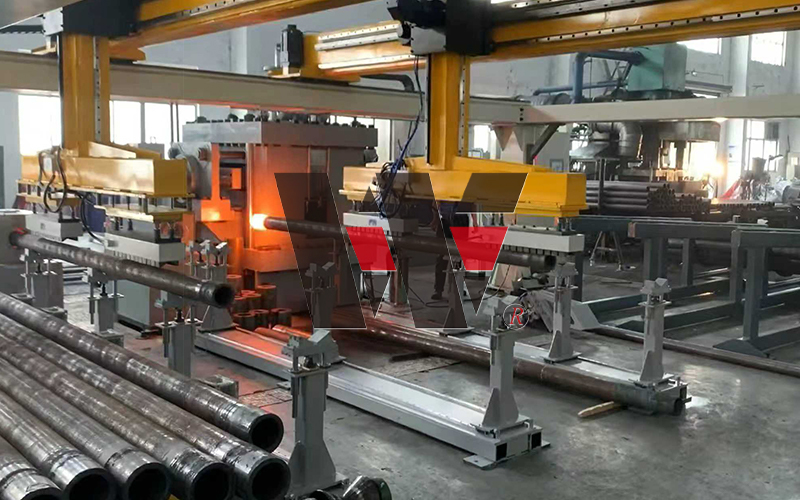 Drill Rod Upsetting Induction Heating Equipment Suppliers, Custom Factory - WuxiWuxi Weineng is Customized Drill Rod Upsetting Induction Heating Equipment Suppliers and Factroy in China, This drill rod upsetting induc...View Product →
3. Upsetting in a Dedicated Machine
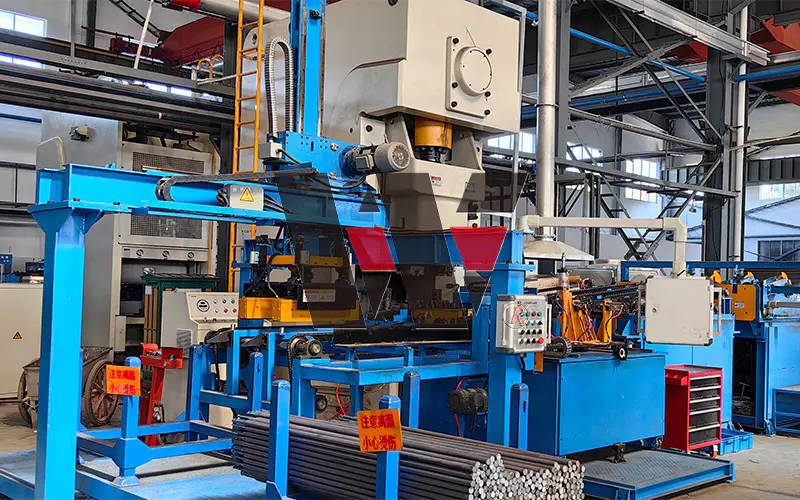
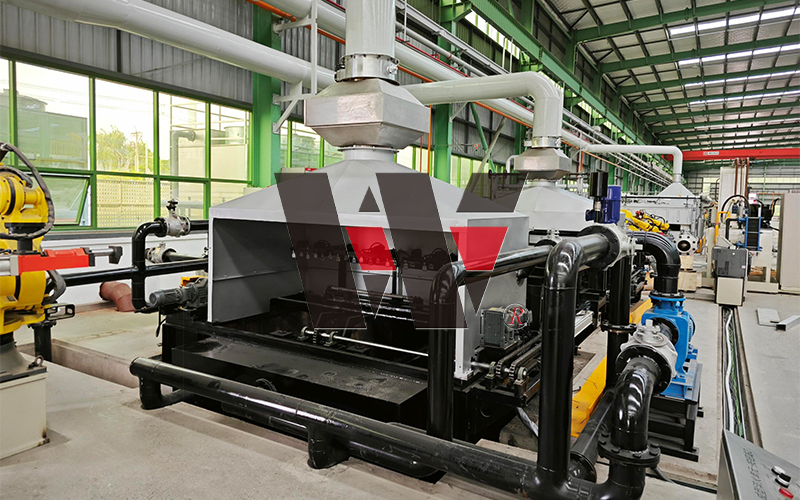
The heated end is transferred directly into a hydraulic upsetting machine for drill rods, where a clamping die grips the cool section of the tube while a horizontal ram advances the forming tool. The forging operation may require one to three strikes depending on the upset ratio, total reduction, and the need to form both internal and external profiles in separate stations. Modern multi‑station machines allow progressive die cavities within a single cycle, reducing material handling and maintaining temperature consistency. The closed‑die design ensures repeatable tong length, wall thickness, and concentricity.
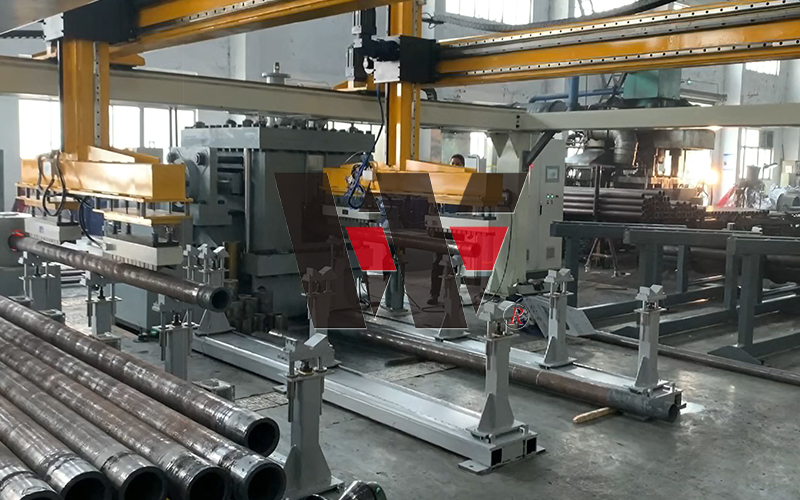 Drill Rod Upsetting Machine Suppliers, Custom Factory - Wuxi Weineng Automation Wuxi Weineng is Customized Drill Rod Upsetting Machine Suppliers and Factroy in China, The core forming unit of the drill pipe upsetting ...View Product →
4. Heat Treatment for Mechanical Properties
Immediately after forging, the upset end and the adjacent tube transition zone possess a coarse, non‑uniform grain structure and residual stresses. The entire pipe enters a normalizing or austenitizing furnace, followed by quenching and tempering to achieve the required mechanical properties—typically a minimum yield strength of 120 ksi (827 MPa) for premium drill rods. A full‑length heat treatment ensures the upset region and the tube body share the same hardness and toughness, a uniformity that friction‑welded assemblies cannot match.
5. Precision Machining and Threading
The upset end is machined on a CNC turning center to produce the final outer and inner diameters, the 18‑degree shoulder face, and API‑specification rotary‑shouldered connections. Thread form accuracy is verified with calibrated ring and plug gauges. Because the upset already provides near‑net shape, machining stock removal is minimal, which reduces cycle time and preserves the compressive residual stress layer imparted by hot forging.
6. Inspection and Quality Control
Every upset undergoes a combination of ultrasonic shear‑wave testing to detect internal discontinuities, dimensional inspection using laser‑based gauging, and hardness testing at multiple locations. A dedicated upset‑gauge template confirms the presence of sufficient wear allowance for re‑threading during field service. Records are traceable to the heat number, ensuring full material pedigree for the end user.
Upset Forged vs. Friction Welded Drill Rods
The decision between an integrally forged upset and a friction‑welded tool joint has a direct influence on total cost of ownership, especially in harsh drilling environments. The table below distills the key engineering differences.
| Feature | Upset Forged (IEU) | Friction Welded |
|---|---|---|
| Weld Seam | None (single piece) | Circumferential weld interface |
| Grain Flow | Continuous, follows upset contour | Disrupted at weld line |
| Fatigue Resistance | No stress concentration from a weld toe | Heat‑affected zone acts as a crack initiation site |
| Hardness Uniformity | Consistent through entire length | Gradient across weld and HAZ |
| Re‑thread Capability | Substantial upset material allows multiple cuts | Limited by tool joint geometry and weld location |
Ring‑weld failures represent a major cause of premature drill rod retirement. The fusion line of a friction weld forms a metallurgical notch that is difficult to inspect reliably with conventional ultrasonic techniques, because the echo pattern from the bond line can mask small discontinuities. An upset‑forged end provides a homogeneous cross‑section that yields clearer NDT signals and higher confidence in remaining life assessments. Field data indicate that IEU rods consistently outperform welded assemblies in horizontal and directional drilling applications where cyclic bending moments are high.
Key Equipment for Drill Rod Upsetting
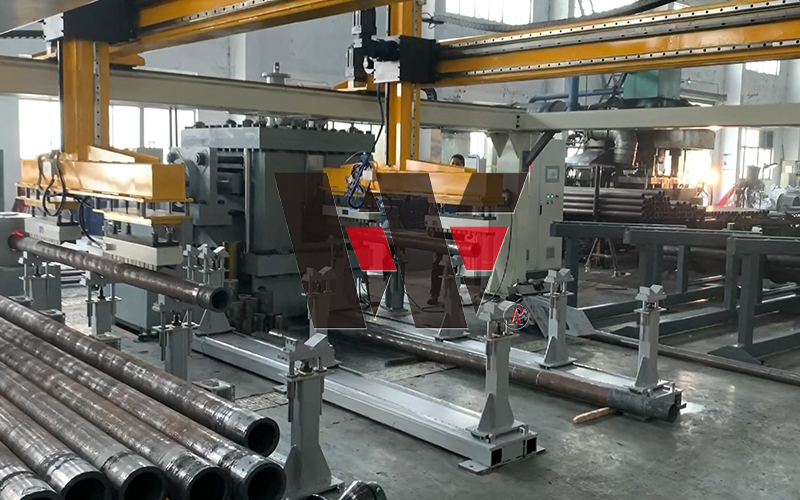
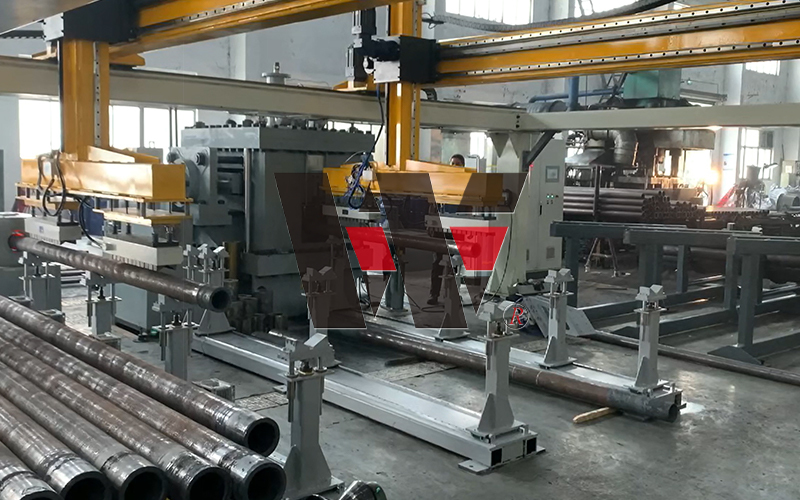
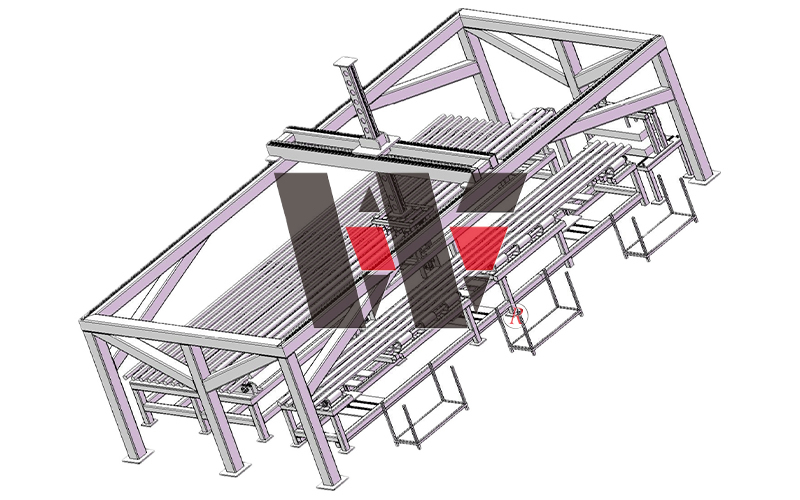
Building a reliable upsetting cell requires integrating four core machine types, each matched to the specific material grade, diameter range, and production volume. A complete drill pipe upsetting production line coordinates these stations with automatic transfer systems, minimizing manual handling and thermal loss between operations.
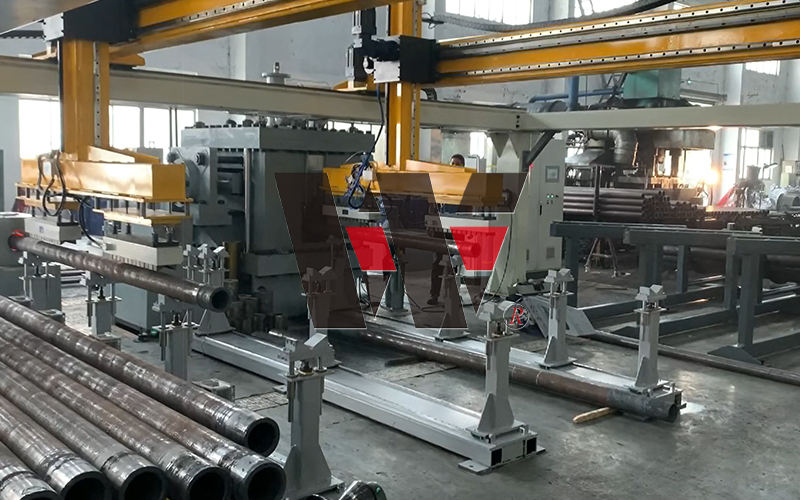 Drill Pipe Upsetting Production Line Suppliers, Custom Factory - Wuxi Weineng AuWuxi Weineng is Customized Drill Pipe Upsetting Production Line Suppliers and Factroy in China, The drill pipe upsetting production line ...View Product →
The induction heater must deliver consistent power density across multiple tube diameters. Look for systems with IGBT‑based power supplies and closed‑loop temperature control, as these allow rapid recipe changes when switching between 2‑3/8 in and 5 in drill pipe. The upsetting machine itself requires a clamping force range that can hold the tube without slipping while the upsetting ram exerts up to several hundred tons. For alloy steels, a four‑column, horizontal‑forged machine with programmable stroke length and dwell time offers the repeatability needed for tight dimensional tolerances. After upsetting, an in‑line normalizing furnace brings the entire pipe to uniform temperature, followed by a quenching system with adjustable spray rings to control cooling rate along the length. Finally, CNC turning centers equipped with automated loading and unloading complete the threading operation at production tempo.
Vendors who supply a fully integrated line with a common control architecture reduce commissioning time and enable single‑source accountability for throughput and part quality. When evaluating a line, confirm that the supplier can demonstrate documented OEE (overall equipment effectiveness) data from reference installations.
How to Choose a Reliable Upsetting Equipment Supplier
Selecting a partner for drill rod upsetting equipment goes beyond a catalogue of machine specifications. Five evaluation criteria help separate a vendor with genuine domain expertise from a general‑purpose forging equipment builder.
First, examine their experience with oil country tubular goods (OCTG) and specifically drill rod geometries. A supplier that has engineered multiple end‑forming lines for standard and heavy‑weight drill pipe understands the interdependence of heating cycles, die wear, and post‑forging heat treatment. Ask to see dimensional capability reports from run‑off tests that cover critical features such as upset taper angle and internal concentricity.
Second, evaluate the scope of turnkey delivery. An ideal partner supplies not only individual machines but a fully synchronized production line, including material handling, cooling systems, and centralized HMI. This approach ensures that heating, upsetting, and heat treatment are tuned as a system rather than optimized in isolation.
Third, scrutinize after‑sales support and spare‑parts strategy. Look for a supplier with remote diagnostic capability, on‑site commissioning engineers, and a documented inventory of critical wear components (induction coils, die inserts, clamping jaws). Downtime in a drill rod manufacturing cell rapidly erodes margins, and a supplier who commits to rapid‑response service agreements protects your capacity.
Fourth, verify that the control philosophy aligns with your workforce skills. Modern lines incorporate industrial Ethernet, OPC‑UA connectivity, and recipe management that reduce changeover time and permit process traceability. The supplier should provide detailed functional specifications before final design approval.
Finally, request references from operators running similar production volumes and material grades. Visits to active installations reveal the real‑world robustness of the material handling system, the accuracy of the induction heating control, and the longevity of the upsetting tooling.
-
Do You Have Any Questions?
Let's
Discuss! -
Quick
Home Products / Equipment About Us Services Application News Contact Us -
Product Categories
Automobile Leaf Spring Complete Equipment Automobile Stabilizer Bar Complete Equipment Automobile Spring Complete Equipment Automotive guide arm complete equipment Oil Drilling Pipe Complete Equipment
-
Email Us
[email protected] [email protected] -
Address
Yangxiyuan Village, Luoshe Town, Huishan District, Wuxi City, Jiangsu Province, China -
Call Us Now
+86-18151713891 +86-18961722255 +86-18961507976 -
WhatsApp
+86-18151713891 +86-18961507976
Copyright © 2026 by Wuxi Weineng Automation Technology Co., Ltd. All Rights Reserved.
 Automotive Suspension Spring Production Line Turnkey Solutions
Automotive Suspension Spring Production Line Turnkey Solutions