Why the Production Line Sequence Matters
A leaf spring passes through eight to ten distinct stations before it ever reaches a truck axle, and each station inherits the tolerances left by the one before it. A blank cut half a millimeter off spec will not always show up until the part fails a fatigue test three stages later. That is the operating reality for anyone specifying or running a leaf spring line: the equipment has to work as a system, not as a collection of independent machines.
This matters most at the handoff points. Material moving from punching into rolling, or from rolling into heat treatment, carries thermal and dimensional history that the next station has to accommodate. A production line built around consistent cycle times and matched tooling holds tolerance across the whole run; a line assembled from mismatched standalone units usually does not, no matter how good any single machine is on its own.
Blanking and Punching: Setting the Foundation
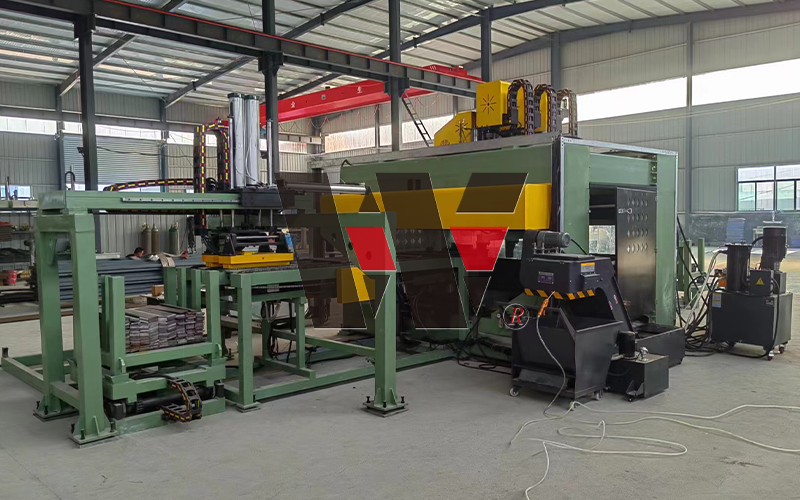
Blanking is where dimensional accuracy either gets built in or gets lost for good. The blank's length, width, and hole positions are cut before any heating or forming happens, so any error here compounds through rolling, ear forming, and final assembly. A fully automatic blanking and punching line combines shearing, feeding, and hole-punching into one synchronized sequence, which removes the manual repositioning that causes most of the variance in batch-to-batch consistency.
Press configuration is the main decision point here. A three-station press handles simpler blank geometries with fewer dies, which keeps changeover time short for high-volume, low-variety runs. A four-station press adds a dedicated operation — commonly a secondary punch or trim — for parts that need extra hole patterns or edge features without a second pass through the line. The right choice depends less on part complexity in isolation and more on how many part variants run through the same line in a given week.
Punch force and die wear are the two variables worth tracking daily. Spring steel work-hardens faster than mild steel, so die inspection intervals on a leaf spring line typically run shorter than on general sheet metal equipment.
Unloading and Material Handling Between Stages
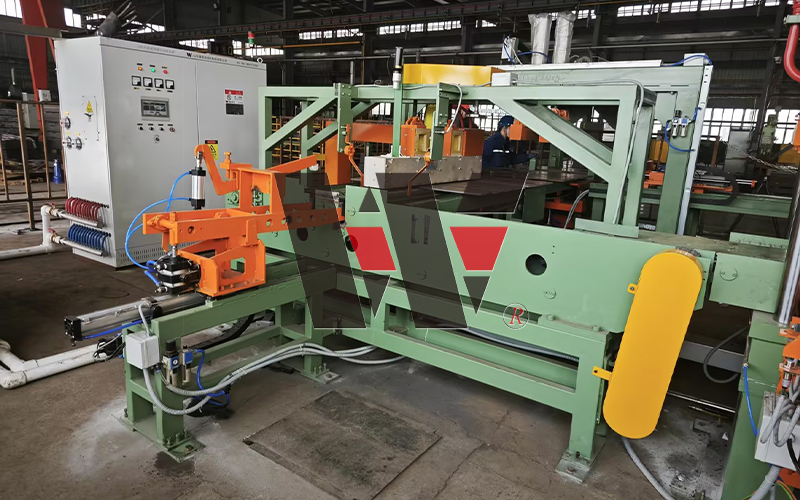
Between each major process, blanks or semi-finished parts have to move without picking up scratches, dimensional shift, or downtime waiting on an operator. Automated unloading and transfer systems keep parts moving at the same cadence as the upstream press, which is what actually determines a line's real throughput — not the rated speed of any single machine.
This is also where most unplanned stoppages originate on older or retrofitted lines. Manual transfer between stations introduces variable dwell time, and dwell time before heat treatment specifically affects how consistently parts respond to induction heating later in the process. Lines designed with continuous handling from blanking through to the hot-forming stages generally show tighter cycle-time variance across a full shift.
Hot Stamping and Variable Cross-Section Rolling
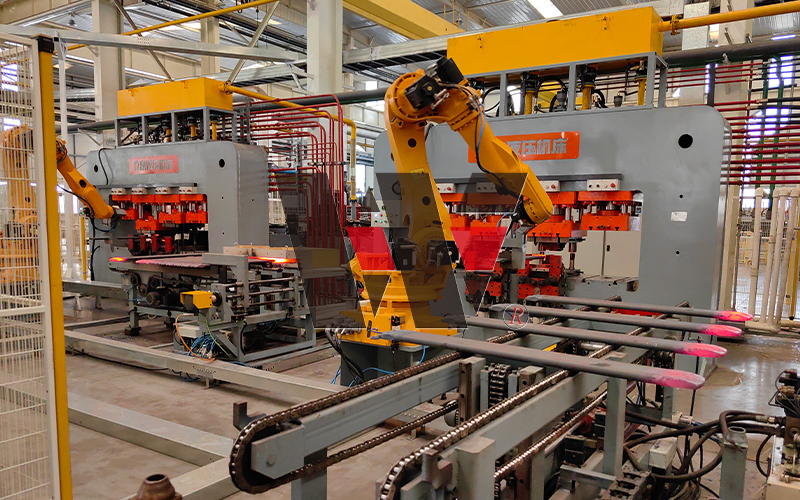
Once blanks are heated, two things happen in close sequence: hot stamping shapes the center bolt hole and camber profile, and rolling reduces thickness along the length of the spring to match the required stiffness curve. For lightweight leaf spring designs, thickness has to vary continuously along the part rather than stepping down in fixed increments — this is where a variable cross-section rolling production line earns its cost over a fixed-profile mill.
Variable cross-section rolling lets manufacturers cut material usage on parts of the spring that don't carry peak load, which is a direct lever on vehicle weight without sacrificing load capacity where it's actually needed. The tradeoff is tooling complexity: the rolling profile has to be programmed and validated for each part number, so this equipment pays off fastest on lines running multiple spring variants for different vehicle platforms rather than a single high-volume part.
Induction heating uniformity directly affects rolling accuracy at this stage. Uneven heating leaves soft spots that roll thinner than intended, which shows up as a stiffness deviation that's expensive to catch later.
Ear Rolling, Ear Wrapping, and End Processing
The eye — where the spring mounts to the vehicle chassis — goes through its own heating and forming sequence, separate from the main rolling stage. Ear rolling curls the heated end into shape; ear wrapping, used on heavier-duty springs, adds a reinforcing wrap layer around the eye for extra load-bearing capacity at the mounting point. Short-cone forming handles the transition section between the tapered body and the eye on parabolic spring designs.
End processing — trimming, edge rounding, and final hole finishing — happens after forming but before drilling. Getting the sequence right here matters: forming the eye before final trimming avoids distorting a feature that's already been finished to tolerance.
Drilling Operations
Center bolt holes and any secondary mounting holes are drilled once the part geometry is stable, typically after rolling and ear forming but before heat treatment. Drilling spring steel at this stage — while it's still in an annealed or semi-hardened state — is significantly easier on tooling than drilling after quenching, which is one reason the sequence is fixed this way across virtually every production line design.
Hole position tolerance here has downstream consequences for assembly: a bolt hole off-center by even a small margin changes how load distributes across a stacked leaf spring assembly, which shows up later as uneven wear between leaves.
Heat Treatment: Quenching and Tempering
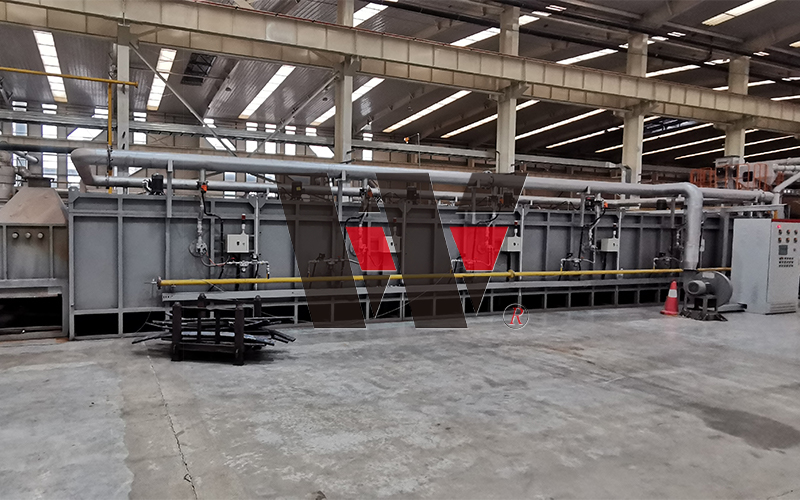
This is the stage that determines whether a leaf spring survives a million load cycles or fails at a fraction of that. Parts are heated to a specific austenitizing temperature, quenched rapidly to lock in a hardened microstructure, then tempered at a lower temperature to relieve internal stress and restore enough ductility to prevent brittle failure. A fully automatic heat treatment production line keeps the timing between quench and temper consistent across every part, which matters because delays between the two steps allow stress cracking to develop in some steel grades.
Furnace atmosphere control affects surface quality as much as core hardness does — an uncontrolled atmosphere leads to decarburization, a soft layer at the part's surface that becomes the starting point for fatigue cracks under repeated flexing. This is also where shot peening typically follows, compressing the surface layer to counteract exactly that failure mode.
Hardness testing and camber height verification happen immediately after tempering, before parts move to assembly. Catching a hardness deviation here is far cheaper than catching it after the spring has been assembled into a finished suspension unit.
Choosing Between a Full Line and Standalone Equipment
Not every manufacturer needs to replace an entire line at once. A plant with a working blanking and rolling setup but an aging, inconsistent furnace can often justify replacing just the heat treatment stage — the return on a single bottleneck fix is usually faster and easier to budget than a full-line overhaul.
A full, integrated line makes more sense when throughput targets are increasing, when a new part program requires process steps the current setup can't handle (variable cross-section rolling being a common trigger), or when manual handling between stages has become the limiting factor on output. For manufacturers planning a new production facility or a major capacity expansion, sourcing complete equipment for automobile leaf springs as one coordinated line avoids the integration risk of matching machines from different suppliers with different control systems and cycle times.
Either path comes down to the same question: which stage is currently limiting your output or your consistency, and does fixing it require a standalone machine or a redesign of how stages connect to each other.
 [email protected]
 +86-18961722255


 English
 русский
 Español
 Automotive Suspension Spring Production Line Turnkey Solutions