Where Quenching Sits in the Leaf Spring Heat Treatment Cycle
A 60Si2Mn leaf spring blank comes out of the forming press already hot, and what happens to it over the next few minutes decides whether it holds up for a million load cycles or cracks well before that. Heat treatment for leaf springs runs through four stages: austenitizing, quenching, tempering, and stress relief. Quenching is the stage that locks in hardness, and it's also the stage where a poorly built furnace does the most damage.
Heating alone doesn't harden steel — the material only hardens if it drops from the austenitizing temperature to below its transformation point fast enough to form martensite. That drop happens inside the quenching furnace, in whatever medium the furnace uses to cool the part. Get the temperature window, the medium, or the furnace's cooling uniformity wrong, and no amount of correct tempering afterward will fully make up for it. For a full walk-through of every station before this one, see this production line guide from blanking to heat treatment.
Austenitizing Temperature: Why a Few Degrees Matter
Most automotive leaf spring steels reach their austenitizing window somewhere between 850°C and 900°C, with 60Si2Mn typically preheated toward the lower end of that range before final heating. The margin for error is narrow. Push the temperature too high and austenite grains coarsen, decarburization accelerates, and the finished spring loses both strength and fatigue limit. Run it too low and the structure transforms unevenly, leaving soft spots that fail under repeated bending long before the rest of the part.
Thickness changes the math as well. A spring leaf around 6.5mm thick needs only a couple of minutes of holding time to reach a uniform temperature through its cross-section, while a 12mm leaf needs closer to five. A furnace that applies one fixed cycle to every thickness will always undertreat some parts and overtreat others. This is one reason preheating and final heating are often split across separate stages — a setup covered in more detail in this piece on induction heating in automotive spring manufacturing.
Quenching Medium and Cooling Rate: The Trade-off Between Hardness and Distortion
Oil is the standard quenching medium for leaf springs, and for good reason. It cools fast enough to form martensite but slow enough to keep distortion and cracking within a manageable range — unlike water, which hardens more aggressively but warps thin sections and raises the risk of quench cracks. Oil temperature matters too: most shops hold the quench bath between roughly 50°C and 80°C, since oil that's too cold cools unevenly across a batch and oil that's too warm slows the cooling rate below what the steel needs.
Cooling rate doesn't just set hardness — it sets the residual stress profile left in the surface of the part. Research on high-speed water quenching of spring steel has shown that generating strong compressive residual stress at the surface can extend fatigue life well beyond what a standard quench and temper cycle achieves on its own, which is part of why shot peening is often layered on top of heat treatment rather than treated as optional. The takeaway for leaf spring production: the quenching stage isn't just a hardening step, it's where a large share of the part's eventual service life gets decided, as this research on residual stress and fatigue performance in spring steel demonstrates.
How Furnace Design Turns Process Parameters into Consistent Spring Life
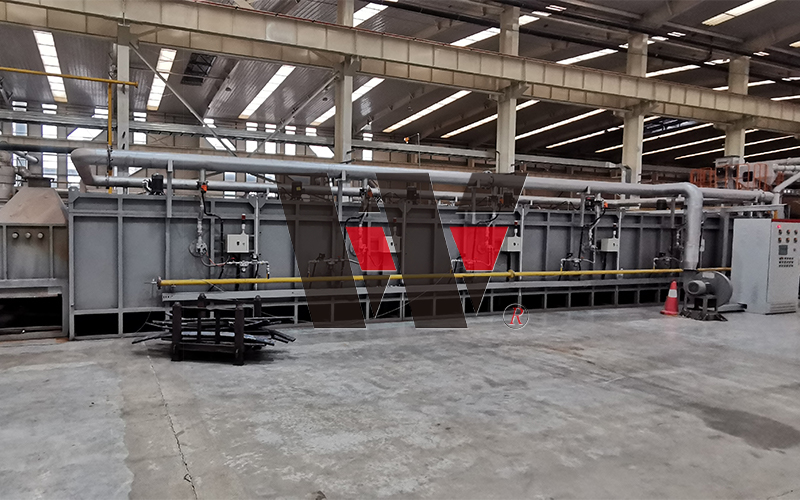
Two furnaces can run the same temperature setpoint and still produce different results. What separates them is uniformity — how evenly heat is distributed across the chamber, how consistently parts are loaded, and how well the oil bath's temperature and circulation are controlled batch after batch. A furnace with poor temperature distribution will harden the leaves near the burners correctly while undertreating the ones at the back, and no downstream inspection catches that until the part fails in service.
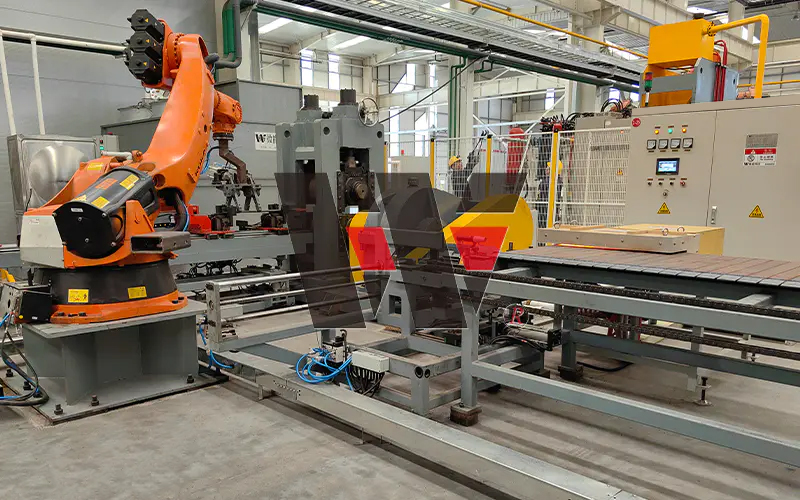
Loading matters just as much as the furnace itself. Leaves stacked too densely block even heat exposure, while scattered or uneven loading causes some parts to overheat while others lag behind. A dedicated quenching furnace designed for leaf spring loads addresses this with controlled loading paths and stable oil temperature management, which is also why quenching performs more predictably when it's built into a fully automatic leaf spring heat treatment production line rather than run as an isolated, manually loaded step.
Common Quenching Defects That Shorten Spring Life
Four defects account for most of the fatigue failures traced back to heat treatment. Decarburization strips carbon from the surface layer during heating, leaving a soft skin exactly where bending stress concentrates. Overheating coarsens the grain structure and can trigger quench cracking, since a coarse structure transforms with more volume change and internal stress than a fine one. Uneven cooling from poor oil circulation or bad loading produces distortion that either scraps the part outright or forces costly straightening. And secondary temper brittleness — a known risk when parts cool too slowly after tempering — quietly reduces toughness in a way that doesn't show up until the spring is already in service.
- Decarburization from unprotected or poorly controlled furnace atmosphere
- Grain coarsening and cracking from excessive austenitizing temperature
- Distortion from dense or uneven furnace loading
- Secondary temper brittleness from slow post-temper cooling
Each of these is a process control problem before it's a materials problem. The furnace, the loading method, and the cooling system are what determine whether they show up.
Tempering and Verification: Closing the Loop on Spring Life
A quenched leaf spring is hard but brittle, and it stays that way until it's tempered. Tempering typically runs between 420°C and 520°C, softening the martensite just enough to bring the part into its target hardness range — commonly 40 to 47 HRC for automotive leaf springs — while restoring the toughness needed to survive repeated flexing. Parts are usually cooled quickly in water right after tempering rather than left to cool slowly, since a slow cool through the wrong temperature band is exactly what causes secondary temper brittleness.
None of this is worth much without a way to confirm it worked. A properly controlled tempering furnace built for consistent post-quench control gets the hardness and toughness into range, and a fatigue testing machine to verify spring life after heat treatment is what turns that into a measurable, repeatable number rather than an assumption.
What to Look for When Choosing Heat Treatment Equipment
Buyers evaluating a quenching or tempering furnace for leaf spring production are really evaluating consistency, not just temperature range. The questions worth asking before ordering matter more than the spec sheet alone:
- How tight is the temperature uniformity across the full chamber, not just at the sensor location?
- Is oil temperature actively controlled and circulated, or does it drift as batches run through?
- Does the loading system prevent the dense stacking that causes uneven heating?
- Is there a protective atmosphere or coating step to control decarburization?
- Can the furnace be integrated into an automatic line with the upstream forming and downstream tempering stages, or does it require manual transfer between steps?
A furnace that answers all five well tends to produce leaf springs with a tighter hardness spread and a longer, more predictable fatigue life — which is the whole point of the heat treatment stage in the first place.
 [email protected]
 +86-18961722255


 English
 русский
 Español
 Automotive Suspension Spring Production Line Turnkey Solutions